Showing posts with label literature. Show all posts

Sunday, September 9, 2012

The Literary Conspiracy


            I take my job as an amateur internet writer very seriously, which means I’ll take any interview that will score me a lot of hits.  Even, as was the case yesterday, if most of those hits are self-inflicted kicks to the skull.  I was loitering in the halls of an upscale hotel near LAX, minding my own business, when I noticed a line of people in suits carrying notepads and tape recorders was forming outside one of the suites.  With nothing better to do, I got in line. 

            I was the last person in line, and after about forty-five  minutes I found out that this was a press junket for Stephenie Meyer, talking about life after Twilight.  If my years on the internet hadn’t taught me how to control my gag reflex, this article would have had a very different ending.  I sat down in a plush leather armchair across from Meyer, the spacious suite suspiciously lacking any bodyguards, personal assistants, or anyone else for that matter.  Something seemed off.

            “So,” I said, after an awkward silence, “What’s next for an author of your stature?”

            “I’d like to do some high-concept avant-garde work.”

            “I see.”  I made a mental note to make sure ‘stature’ means what I think it does.  I was about to say something else, but then I noticed that Meyer’s head was twitching violently back and forth.  “Are you okay?” 

            A few things tipped me off that she was not okay.  The first is that she started repeating the same word over and over again.  The second is that that word was ‘Error.’  By the time sparks started flying out of her ears, I was pretty sure something was amiss.  When the sparks had stopped for long enough that I was confident she wouldn’t catch fire or explode or spawn Meyer-nano-bots, I opened the suitcase sitting next to her seat.  (It’s perfectly legal to look through someone’s stuff if you’re there when they died; it says so in the sixth amendment.)   What I found was evidence of a conspiracy so complex and far-reaching that it is almost too stupid to believe. 

            The suitcase contained all the information on ‘Literary Contingency Plan Theta.’  Which, the cover sheet informed me, was designed to ‘inspire book sales in the otherwise illiterate in a manner that will anger the more literary among the populace, prompting them to buy quality books.’  It appeared that a number of authors all wrote their own version of Twilight, and those versions were then compiled and distilled into a garbled mess, i.e., a bestseller.  I was able to retrieve brief excerpts of the various versions of the story before the Meyer-bot self-destructed.  This conspiracy goes back longer than I would have dared to imagine, and could completely rewrite literary history.  The authors mentioned hereafter will, undoubtedly, deny any involvement.

Cormac McCarthy:

            See the girl.  She sat in the back of an old car.  Thunderheads galloped through the sky above, below the fog-muted greens of the treetops rattled in the cold seawind from the west, carrying the salt laden air inland. An alien world unlike the interminable expanse of orange and gold that was Arizona.  The girl stirs.  When will we get there?  she asks.  There is a man driving, he does not turn to her when he speaks.  Another hour, or so.

            That long?

            It’s the weather.

            The hill crests before them, at the peak they can see the town under siege from the rain that has sprung up out of nowhere.

Michael Cricthon:

            “So the enzyme in your saliva is responsible,” Bella asked.

            “Exactly,” Dr. Cullen explained.  “Once in the bloodstream, the enzyme enters the DNA of the individual cells, much in the same fashion of the naturally occurring thyroid hormone, tri-iodothyronine.  The enzyme rewrites the DNA to, first of all, produce more of the enzyme.  Then it prevents the shortening of telomeres, which halts the aging process.  However, it inhibits erythropoiesis, the production or erythrocytes, better known as red blood cells.”

            “But what about your super strength?”

            “If we look at the muscle fibers we –

Thomas Pynchon:

            He held her, pressed up against an eldernly oak.  She turned her head, could see an eroded etching in the bark, made out that it said ‘Ron + Jenny Always.’  They had put that there in 1952.  Ronald Hopefalls was a sailor aboard the aircraft carrier U.S.S. Mishap, which had anchored safely in Seattle after six months off the coast of Thailand.  Ronald had bartered for a ride south from Seattle, he traded a sterling silver pendant that he had stolen from a drunk in Bangkok.  The pendant appeared to be a meaningless series of criss-crossing metal mesh, but when a light shone through it, it cast shadows depicting various methods of fellatio depending on the angle and intensity of the light.

Bret Easton Ellis:

            I am wearing an Abercrombie and Fitch black polyester-blend tee-shirt, Hot Topic tattered denim blue jeans and black and gray Converse sneakers with white laces.   I’m trying to get to English class when I see Mike coming towards me.  I don’t want to deal with him.

            “You look really nice today,” he says.

            Please go away.

            “Thanks.”

            He shuffles his feet like a moron and I know what he’s going to ask.  It’s embarrassing to watch.

            “Do you want to go to prom with me?”

            I’d rather slit open my abdomen and eat whatever comes out.

            “I’m not going.”

            He looks broken and walks away.  I should suggest a girl for him to take out, just so I won’t have to deal with how pitiful he looks.  Half the guys here have asked me out, like they think that just because I’m the new girl, I’ll drop my panties for the first nice guy that comes along.  Why not?  There’s nothing else to do in this shitstain of a town.

Ernest Hemingway:

            They thought the man had been torn apart by wild dogs.  The carcass was ragged with teethmarks.  I listened to my father relate the investigation.  They found a second body.  Now they think a man did this.  He is going to search the woods for the killer.  He told me he loves me and left.  I poured myself a drink.

Geoffrey Chaucer:

And eek sporte hadde he,

But condiciouns ther neede be.

The shoures soote  loved hem alle,

For thanne koulde folks playen balle.


Saturday, September 1, 2012

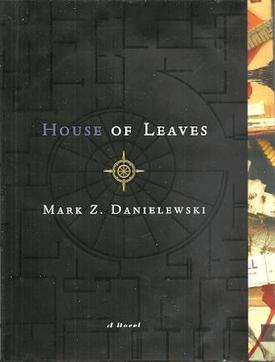
Book Review: House of Leaves


            Mark Z. Danielewski’s House of Leaves is proof that there are still unexplored avenues in horror and experimental literature.  Danielewski takes the old mantra of “show, don’t tell” to its extreme, sculpting the layout of the pages to show the characters’ mental states and even, occasionally, their physical location.  Alternating between agoraphobic (a single paragraph at the bottom of a page) and labyrinthine (footnotes running through the text in multiple directions), House of Leaves is an exercise in form as an integral part of story-telling. 

            It was no coincidence that I used the term labyrinthine in the previous paragraph.  Both the story and the form it takes are like a labyrinth (an analogy the author (but not the narrator) of the novel within the novel also makes); getting lost in the branching corridors of the lives of Will Navidson, Zampanó, and Johnny Truant is easy, but you will be greatly rewarded if you can find the right path. 

            If you have not read House of Leaves, you’re probably wondering what the heck I’m talking about with novels within novels and sideways footnotes.  There are three main stories in House of Leaves.  That of Johnny Truant, who found a manuscript among the belongings of the deceased blind man known only as Zampanó, the story within the novel itself, and the story of Zampanó.  The bulk of House of Leaves is comprised of Zampanó’s novel, The Navidson Record, which is written to look like a non-fiction exegesis on a fictional documentary of the same name.  It follows the story of an acclaimed photojournalist, Will Navidson, his children, and their mother, as they move into a house in Virginia and try to settle down (Navidson was never around, always documenting wars or disasters).  Navidson got grant money to make a documentary about putting down roots and becoming close as a family.  Things take a turn for the strange as they discover that the house is slightly larger on the inside than on the outside.  Then things become downright spooky as rooms start appearing including mile-long hallways and below-freezing chambers. 


In some editions, the dust-jacket is smaller than the book.


            Because The Navidson Record has taken the form of a scholarly pursuit, footnotes abound.  While not a typical manner of comedic relief (although House of Leaves is anything but typical), the criticism of film (and perhaps literary) criticism is clever, albeit a bit repetitive.  Consider the idea that scholars wrote hundreds, or even thousands, of books and articles were about the physics, symbolism, and nature of the House on Ash Tree Lane, but were either unable or unwilling to go to the house itself.  (If it seems like I’m reaching, Karen, the love of Will Navidson’s life, gets opinions on a clip from the documentary from a number of real-life authors, filmmakers, architects, critics, etc., including Derrida, the father of deconstructionism.  While all the people asked provide different answers, only Derrida is portrayed as spouting incomprehensible nonsense.)

            Among the footnotes Johnny Truant will occasionally interrupt, his life having descended, slowly, gradually, into madness.  His history and his present are mirrored and affected by The Navidson Record and those acquainted with the enigmatic Zampanó. 

            Zampanó doesn’t have his own story, so much as he informs the other stories.  We learn about him through his acquaintances, through the information Johnny digs up, and through what he puts in his novel, or more importantly, what he tries to leaves out.   Sections of crossed out material (including the previously mentioned labyrinth analogy) that Johnny included in his transcription of the novel tell us about its author.  In this way, the book examines the relationship between the author and his work. 

            The way all the storylines interact with each other can be confusing, but creates something greater than the sum of its parts.  It’s not an easy read, but House of Leaves is worth the effort.


Friday, April 20, 2012

Opinions on Fan Fiction

            Like most denizens of the internet, I cringe whenever I come across the words “fan fiction.”  That phrase conjures up images of poorly written adventures and anatomically erroneous erotica.  And, quite frankly, a majority of fan fiction falls into one of those two categories.  But then again, so does a majority of fiction in general.  I was thinking about writing a post on fan fiction, prompted by the release of “Fifty Shades of Grey.”  I ran into a problem from the outset: I couldn’t define fan-fiction.  I tried.  My first definition was “a work of fiction that is based on and uses the characters from one or more previously existing sources.” 
            This was a seemingly fit catch-all until I thought of Jason Bourne.  I haven’t read any of the novels written after Ludlum’s death, but there have been several.  Are they fan-fiction?  It certainly fits the definition.  As do the post-Flemming James Bond novels.  And the Star Wars novels.  So I changed my definition to require works to be non-canon.  Then I thought of Tom Stoppard.
            Tom Stoppard wrote a play titled Rosencrantz and Guildenstern Are Dead (which was adapted into a great film starring Timothy Roth and Gary Oldman), which uses only characters from Shakespeare’s Hamlet.  Clearly this fell into my new definition for fan fiction.  I also recently read a very funny book by Christopher Moore called Lamb: The Gospel According to Biff, Christ’s Childhood Pal, which uses biblical characters in the setting of ancient Jerusalem.  If that’s fan-fiction, so is Milton’s Paradise Lost.  How can I justify being against something when I can’t even define what it is I’m supposed to be against? 
            As I tried to reconcile my gut feelings with my rationality, I started considering another aspect: story.  James Joyce’s Ulysses adapts the Odyssey to be about an average person, all the obstacles are changed from fantastic to mundane.  If using a pre-existing character in a new storyline is fan fiction, is using a pre-existing storyline with a new character also fan fiction?  I don’t know. 
            Is there a lot of shitty fan-fiction out there?  Sure.  But I think it’s worth wading through the oceans of crap to find the half-digested piece of corn that is a good story (and that’s officially the grossest metaphor I’ve ever written).

Sunday, February 26, 2012

"The Giver": An Anti-Communist Interpretation

“The Giver,” is a young adult/tween novel by Lois Lowry, published in 1993.  Like many people my age, I first read “The Giver” in middle school English.  Recently, I reminisced on it, only to discover that it had a quite blatant anti-communism theme.  Now, I’m not one of those people that finds political messages in everything (and I am not now, nor have I ever been, a member of the United States Communist Party).  But in the case of “The Giver,” I think the facts speak for themselves.

If you are unfamiliar with the book, it focuses a boy named Jonas.   It is a dystopian novel, the society initially appearing completely at peace.  In the society he lives in when children turn 12 (all at the same time) they are assigned to the job they will have for the rest of their lives, based on their skills.  Jonas is selected as the “Receiver of Memories,” where he receives the memories of the human race from “The Giver of Memories.”  It is during this process that Jonas (and the reader) discover some of the unpleasantness behind the idyllic civilization.  The community (run by a council of elders) has removed color and music and individuality.  The very elderly and undesirable are “released” (i.e. euthanized).  The story ends with Jonas fleeing his home with a baby that was going to be released.

Let’s take a look at the society.  No form of currency is ever discussed, nor is bartering.  Each family is limited to two children, and even then, these children are the offspring of designated “birth mothers.”  The people are assigned to a job for which they are not paid, but everything is provided for them.
At the outset, the community sounds great (it’s a false utopia, what do you expect?).  A system in which there’s no sickness or pain, and no one is poor or hungry?  That’s a child’s understanding of a communist society.  But then the dark machinations that keep that society running are revealed.

The people are devoted only to the community.  Sexuality (“the stirrings”) is inhibited, as are any romantic relationships. Couples are paired based on temperament.  The only devotion anyone has is to the community and its continued well-being.  When people get too old to be on the work force, they are moved to a nursing home, and are eventually released (compare to the paranoid delusions about “death panels”).

An interesting point of symbolism is Jonas’s gaining the ability to see color.  This happens one color at a time, and (maybe coincidentally, but I doubt it) the first color he sees is red.

A completely secular community where there is no system of currency, people are assigned to jobs, strict birth rate control, and a fiercely collectivist ideology?  It’s basically an exaggerated version of Red China. And when the protagonist realizes the charade, he up and leaves.

I’m not out to criticize Lowry or take sides on economic and social ideologies.  I don’t know if Lowry intended to embed an anti-communist message in her book, but it’s definitely there.