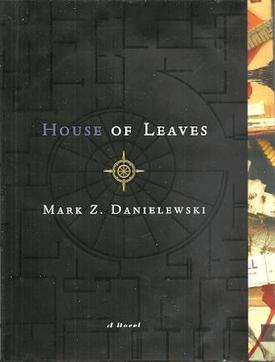
Mark Z.
Danielewski’s House of Leaves is
proof that there are still unexplored avenues in horror and experimental
literature. Danielewski takes the old
mantra of “show, don’t tell” to its extreme, sculpting the layout of the pages
to show the characters’ mental states and even, occasionally, their physical location. Alternating between agoraphobic (a single
paragraph at the bottom of a page) and labyrinthine (footnotes running through
the text in multiple directions), House
of Leaves is an exercise in form as an integral part of story-telling.
It was no
coincidence that I used the term labyrinthine in the previous paragraph. Both the story and the form it takes are like
a labyrinth (an analogy the author (but not the narrator) of the novel within
the novel also makes); getting lost in the branching corridors of the lives of Will
Navidson, Zampanó, and Johnny Truant is easy, but you will be greatly rewarded if
you can find the right path.
If you have
not read House of Leaves, you’re probably
wondering what the heck I’m talking about with novels within novels and
sideways footnotes. There are three main
stories in House of Leaves. That of Johnny Truant, who found a manuscript
among the belongings of the deceased blind man known only as Zampanó, the story
within the novel itself, and the story of Zampanó. The bulk of House of Leaves is comprised of Zampanó’s novel, The Navidson
Record, which is written to look like a non-fiction exegesis on a fictional
documentary of the same name. It follows
the story of an acclaimed photojournalist, Will Navidson, his children, and
their mother, as they move into a house in Virginia and try to settle down
(Navidson was never around, always documenting wars or disasters). Navidson got grant money to make a
documentary about putting down roots and becoming close as a family. Things take a turn for the strange as they discover
that the house is slightly larger on the inside than on the outside. Then things become downright spooky as rooms
start appearing including mile-long hallways and below-freezing chambers.
 |
| In some editions, the dust-jacket is smaller than the book. |
Because The
Navidson Record has taken the form of a scholarly pursuit, footnotes
abound. While not a typical manner of
comedic relief (although House of Leaves is
anything but typical), the criticism of film (and perhaps literary) criticism
is clever, albeit a bit repetitive.
Consider the idea that scholars wrote hundreds, or even thousands, of
books and articles were about the physics, symbolism, and nature of the House on
Ash Tree Lane, but were either unable or unwilling to go to the house
itself. (If it seems like I’m reaching,
Karen, the love of Will Navidson’s life, gets opinions on a clip from the documentary
from a number of real-life authors, filmmakers, architects, critics, etc., including
Derrida, the father of deconstructionism.
While all the people asked provide different answers, only Derrida is
portrayed as spouting incomprehensible nonsense.)
Among the footnotes
Johnny Truant will occasionally interrupt, his life having descended, slowly,
gradually, into madness. His history and
his present are mirrored and affected by The Navidson Record and those acquainted with the enigmatic
Zampanó.
Zampanó doesn’t
have his own story, so much as he informs the other stories. We learn about him through his acquaintances,
through the information Johnny digs up, and through what he puts in his novel,
or more importantly, what he tries to leaves out. Sections of crossed out material (including
the previously mentioned labyrinth analogy) that Johnny included in his
transcription of the novel tell us about its author. In this way, the book examines the relationship
between the author and his work.
The way all
the storylines interact with each other can be confusing, but creates something
greater than the sum of its parts. It’s
not an easy read, but House of Leaves
is worth the effort.